SYNTHESIS AND PHOTOPHYSICAL PROPERTIES OF Zr AND Hf PHTHALOCYANINES WITH OUT-OF-PLANE COORDINATED CHALCONES

Authors

  • Mykhaylo Yu. Losytskyy Taras Shevchenko National University of Kyiv, Faculty of Physics, 64/13 Volodymyrska St., Kyiv 01601
  • Iryna N. Tretyakova V. I. Vernadsky Institute of General and Inorganic Chemistry, National Academy of Sciences of Ukraine, Department of Coordination Complexes N2, 32/34 Palladina Ave., Kyiv 03142
  • Svitlana Chernii V. I. Vernadsky Institute of General and Inorganic Chemistry, National Academy of Sciences of Ukraine, Department of Coordination Complexes N2, 32/34 Palladina Ave., Kyiv 03142
  • Nataliia Fedosova V. I. Vernadsky Institute of General and Inorganic Chemistry, National Academy of Sciences of Ukraine, Department of Coordination Complexes N2, 32/34 Palladina Ave., Kyiv 03142
  • Alexandr Starukhin Institute of Physical Chemistry, Polish Academy of Sciences, 44/52 Kasprzaka, Warsaw 01-224
  • Aleksander Gorski Institute of Physical Chemistry, Polish Academy of Sciences, 44/52 Kasprzaka, Warsaw 01-224
  • Vladyslava Kovalska V. I. Vernadsky Institute of General and Inorganic Chemistry, National Academy of Sciences of Ukraine, Department of Coordination Complexes N2, 32/34 Palladina Ave., Kyiv 03142
  • Viktor Ya. Chernii V. I. Vernadsky Institute of General and Inorganic Chemistry, National Academy of Sciences of Ukraine, Department of Coordination Complexes N2, 32/34 Palladina Ave., Kyiv 03142 https://orcid.org/0000-0003-2057-1639

Keywords:

chalcones, dehydroacetic acid, phthalocyanines, fluorescence, out-of-plane ligands, UV-vis spectroscopy

Abstract

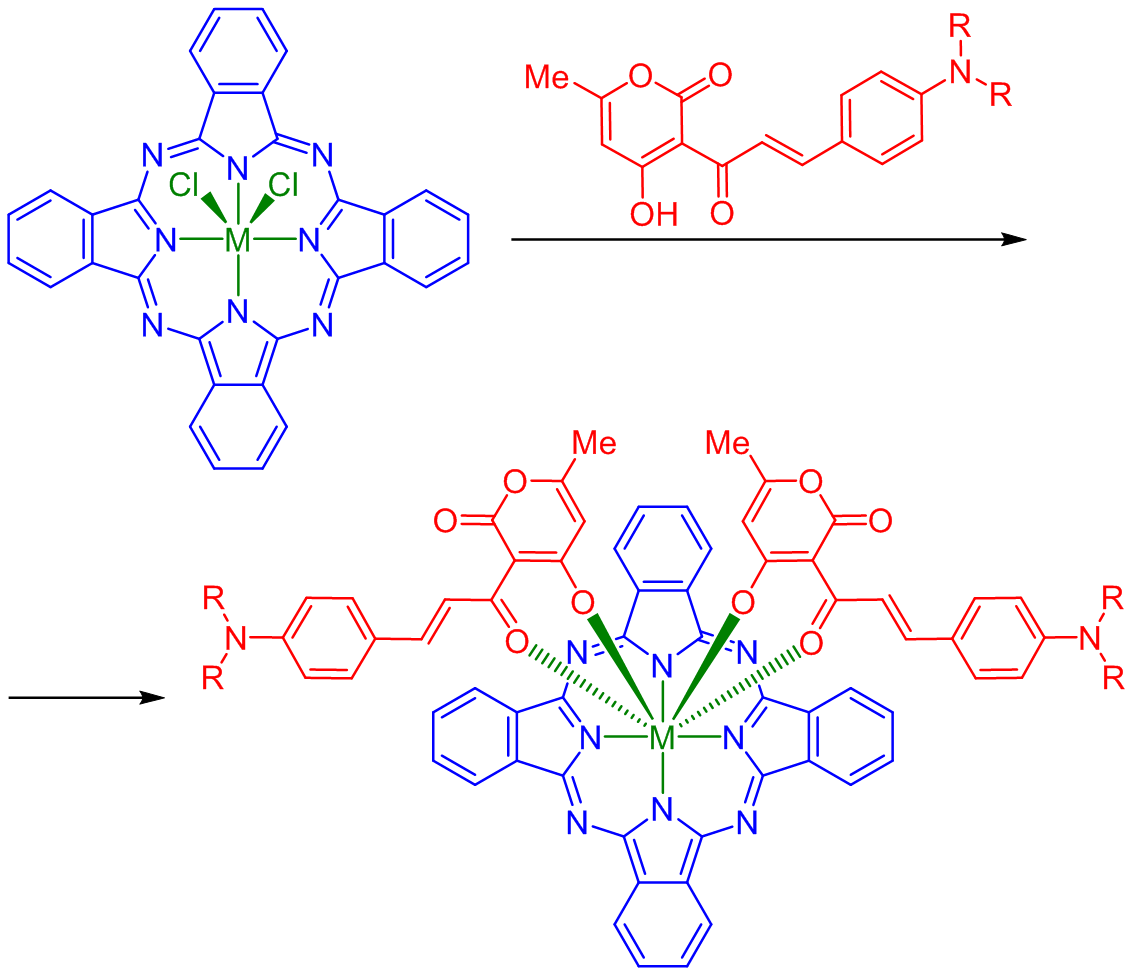
Zr(IV) and Hf(IV) phthalocyanines with chalcone-derived out-of-plane ligands were synthesized and characterized by standard spectroscopic methods. The complexes combine two chromophores, enabling interchromophore interactions that strongly depend on solvent polarity. In toluene, the fluorescence excitation spectra closely follow absorption and include the ligand band, indicating efficient excitation energy transfer to the phthalocyanine core. In acetonitrile, the ligand contribution is weak, consistent with the drastic drop in fluorescence quantum yield of the free ligand (0.2500 → 0.0036). These results reveal pronounced solvent-sensitive photophysical behavior, suggesting that such dual-chromophore phthalocyanines are promising for applications in solar-driven photocatalysis.

Published

2026-02-24