DESIGN AND DISCOVERY OF COMPOUND DXS05 AS A HIGHLY POTENT GSPT1 MOLECULAR GLUE DEGRADER

Authors

  • Li Zhang Hunan Provincial Key Laboratory of the Research and Development of Novel Pharmaceutical Preparations, Changsha Medical University, 1501 Leifeng Avenue, Changsha, Hunan 410219
  • Ling Wang Hunan Provincial Key Laboratory of the Research and Development of Novel Pharmaceutical Preparations, Changsha Medical University, 1501 Leifeng Avenue, Changsha, Hunan 410219
  • Meijing Deng The National & Local Joint Engineering Laboratory of Animal Peptide Drug Development, College of Life Science, Hunan Normal University, Changsha 410081
  • Huiying Wu Hunan Provincial Key Laboratory of the Research and Development of Novel Pharmaceutical Preparations, Changsha Medical University, 1501 Leifeng Avenue, Changsha, Hunan 410219
  • Shuting Zou Hunan Provincial Key Laboratory of the Research and Development of Novel Pharmaceutical Preparations, Changsha Medical University, 1501 Leifeng Avenue, Changsha, Hunan 410219
  • Gang Li Guangdong Key Laboratory of Animal Conservation and Resource Utilization, Guangdong Public Laboratory of Wild Animal Conservation and Utilization, Institute of Zoology, Guangdong Academy of Sciences, Guangzhou, Guangdong, 510260
  • Zonghui Ma Chemical Biological Program, Department of Pharmacology and Toxicology, University of Texas Medical Branch (UTMB), Galveston, TX, 77555
  • Chao Zhang Key Laboratory of Structure-based Drug Design & Discovery, Ministry of Education, School of Pharmaceutical Engineering, Shenyang Pharmaceutical University, 110016
  • Na Liu Department of Cardiovascular Medicine, The Second Xiangya Hospital of Central South University, Changsha, Hunan,410000
  • Xinshan Deng Hunan Provincial Key Laboratory of the Research and Development of Novel Pharmaceutical Preparations, Changsha Medical University, 1501 Leifeng Avenue, Changsha, Hunan 410219

Keywords:

GSPT1, molecular glue, NCI-H1299, urea derivatives

Abstract

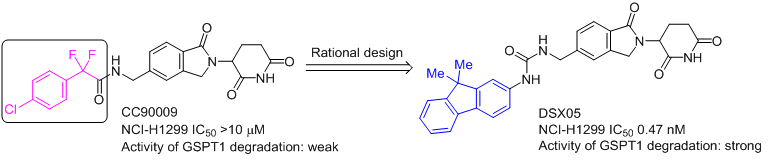
Although the rational design molecular glues poses significant challenges due to their serendipitous discovery, these molecules make the degradation of previously ''undruggable'' proteins possible via the recruitment of cereblon (CRBN) as the target. We conducted a binding model analysis of the CC90009-GSPT1-CRBN ternary complex and ubsequently introduced a hydrophobic 9- or 13-membered polycyclic moiety into the π–π stacking binding region, which led to the design and synthesis of 17 compounds. Among them, DXS05 exhibited superior antiproliferative activity against non-small cell lung carcinoma (NSCLC) NCI-H1299 cells with an IC50 0.47 nM which was superior to the clinical compound CC90009 (IC50 > 10 µM), and DXS05 was identified as an on-target degrader of GSPT1. The robust efficacy of DXS05 may offer a potential new treatment option for unmet clinical patients with GSPT1-associated NSCLC solid tumors in the future.

Published

2026-05-15

Issue

Section

Original Papers