SYNTHESIS OF ARYLPYRIDINES BY Pd(II) COORDINATION POLYMER CATALYZED C–C COUPLING
Keywords:
boronic acids, palladium, phenyl pyridine, C–C coupling, coordination polymer, nanoparticlesAbstract
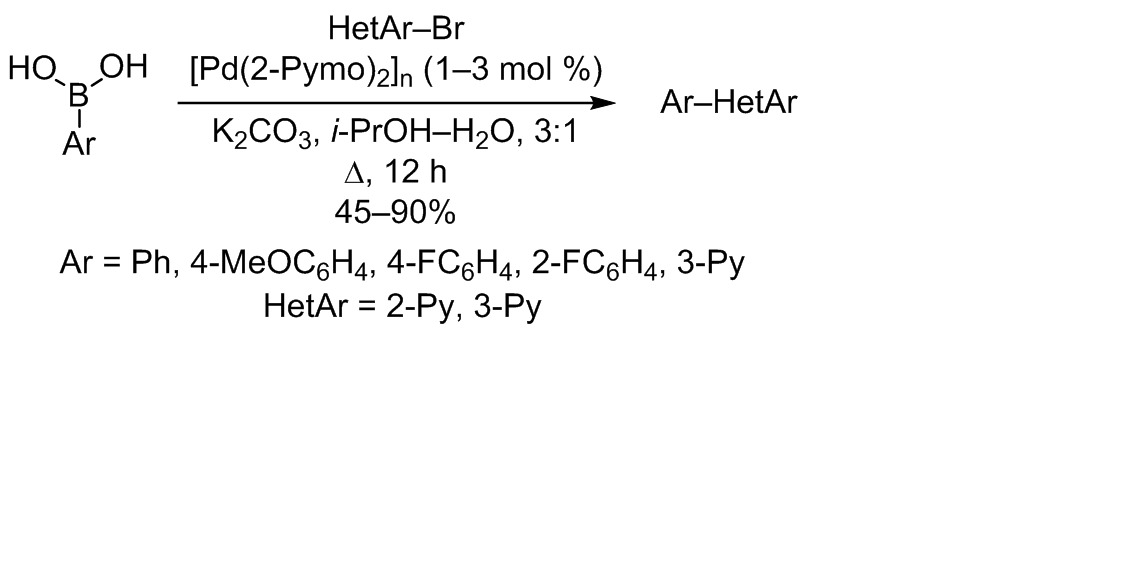
The study was aimed on elucidation of the applicability of Pd(II) coordination polymer [Pd(2-Pymo)2]n (where 2-Pymo– is 2-hydroxypyrimidine anion) as catalyst for C–C coupling of heterocyclic compounds. It was shown that [Pd(2-Pymo)2]n catalyzes C–C coupling of isomeric bromopyridines and arylboronic acids with up to 70% yield at 1 mol % Pd loading, affording the respective phenylpyridines. Coupling of 3-pyridineboronic acid and bromobenzene in presence of [Pd(2-Pymo)2]n gave 3-phenylpyridine with 75% yield at 3 mol % Pd loading. At the same time, the method was not suitable for C–C coupling reactions, involving pyrazoles (both bromopyrazole and pyrazoleboronic acids) and 2-bromopyrimidine. The reaction of phenylboronic acid and 3-bromopyridine proceeded with an induction period, presumably required for in situ formation of ultrafine Pd nanoparticles, responsible for the catalytic activity of [Pd(2-Pymo)2]n. The advantage of the catalyst is low consumption of Pd, which is washed out from the surface of the coordination polymer particles, as well as low price of [Pd(2-Pymo)2]n compared to Pd complexes with phosphines. The solid catalyst may be easily separated after the reaction and reused or regenerated.