EVALUATION OF THE HYDROGENATION CATALYSTS PERFORMANCE BY ANALYSIS OF THE PROBE REACTION PRODUCTS DISTRIBUTION
Ключевые слова:
heteroaromatic pyridines, hydrodechlorination, nitro-group reduction, pyridine ring hydrogenation, supported palladium catalysts, palladium on carbon, GC–MS product profiling, quality control, probe-reaction fingerprinting, chloronitropyridinesАннотация
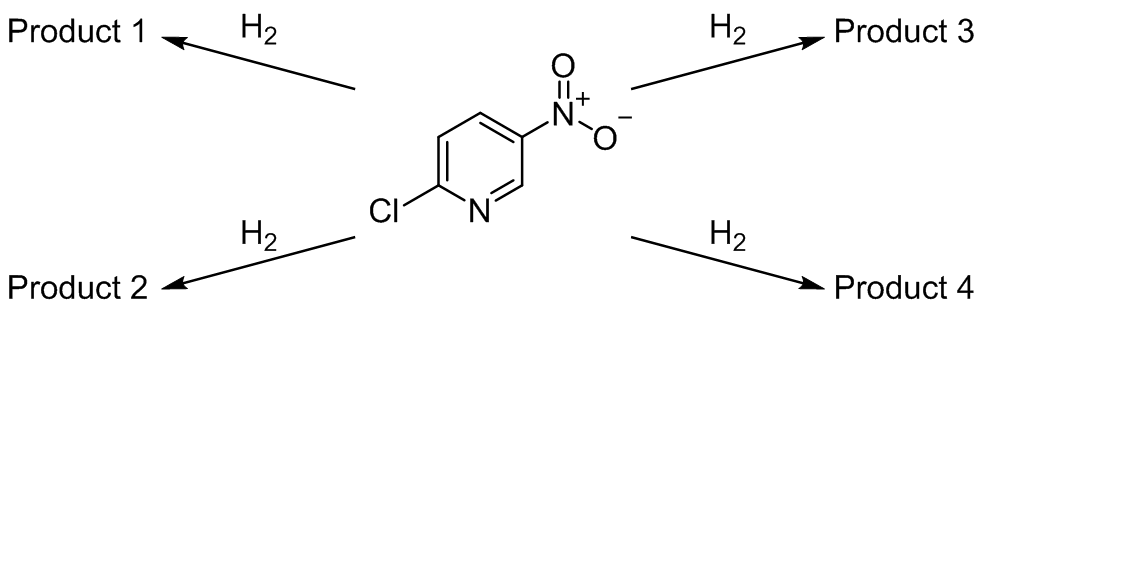
We propose a two-temperature probe-reaction ''fingerprint'' for supported metal nanoparticles catalysts using 6-chloro-3-nitropyridine as substrate. Its reactivity with hydrogen branches between hydrodechlorination, nitro/ring reduction, and deep hydrogenation. GC-MS readouts are expressed as a 12-label set (unreacted, products); centered log-ratio (CLR) profiles at 25 and 50°C are differenced to give a temperature-response vector (ΔCLR). Applied to eight commercial 5 wt % Pd/C catalysts (BASF and Evonik toolkits; H2 30 bar, THF), ΔCLR separates samples by which reaction branch becomes more discriminating upon raising temperature from 25 to 50°C – dechlorination-leaning vs deep hydrogenation-leaning – beyond simple increases in conversion. For quick screening we report conversion, conversion + Cl-free products total, and conversion + selected deep hydrogenation products. Texture/morphology descriptors (SBET, Vmic, Vmeso; Median, CV, TailRatio, area fractions) provide orthogonal quality control, but do not by themselves reproduce ΔCLR groupings. Retention-time labels and inlet-mitigation measures support portability. The workflow enables lot identity checks and early catalyst selection.